
QBLH
A science fiction
esoteric fantasy
by LAZARUS CAIN
aka G T King MS-ECE

QBLH
The Seven of Swords
Betrayal,
Deception,
Stealth
and Futility
Chapter LVII
Herod and the Child
Stealth and trickery
“For what reason, Grandfather?”
“I am not certain,” John replied quietly. “Say nothing to Herod or any of the authorities, Xiang. They are no friends of ours. I am quite sure we shall need to employ our skills to lose our companions and complete the mission in privacy. This is Jim’s undertaking—let him do all the talking.”
Jerusalem did not shock Jim.
That, in itself, unsettled him.
He had arrived expecting dissonance—some sharp fracture between eras—but instead he found continuity. The architecture had changed, the languages had shifted, the uniforms bore different insignia, yet the underlying geometry of occupation remained intact.
He had walked these patterns before—not only in antiquity, but in a world that claimed to have outgrown them.
The streets bore the familiar marks of constrained life: commerce pressed inward upon itself, voices lowered by habit rather than fear, bodies moving with the practiced efficiency of those who knew which routes were permitted and which were not. Poverty here was not accidental. It was managed. Disease lingered openly, not because it could not be addressed, but because it was not a priority.
Rome had imposed order—and with it, stagnation.
Jim recognized the posture immediately. He had seen it in the twenty-first century—places where people were governed without being represented, where authority arrived from outside and justified itself through security, and where entire populations were spoken of as problems rather than persons. The rhetoric differed. The mechanics did not.
The Romans spoke of peace. Pax Romana.
They meant compliance.
They spoke of civilization.
They meant extraction.
The locals were described as volatile, irrational, prone to rebellion—language Jim had heard before, dressed in newer terms. To Rome, these people were barbarians, useful only insofar as they could be controlled. Their traditions were tolerated. Their suffering was irrelevant.
Jim felt no nostalgia for the present he had left behind.
What disturbed him was not that history repeated itself, but that it refined itself. Occupation had grown more efficient over time—more bureaucratic, more procedural, more adept at cloaking coercion in legitimacy. Rome ruled openly. Later empires would learn to rule invisibly.
Xiang sensed the same continuity, though he lacked Jim’s reference points. He felt it as pressure rather than recognition—the subtle, omnipresent constraint that comes when power is always elsewhere. He had once ruled empires that spanned continents. Now he walked among people who could not choose their own governors, their own borders, or even their own narratives.
This, Jim realized, was why the place mattered.
Not because it was ancient—
but because it was unfinished.
The journey toward Jerusalem proved uneventful.
Jim remained deeply engaged with Genie, his attention divided between the road ahead and the data assembling invisibly above it. John, walking nearby, was similarly occupied with his own Merkabah unit, quietly preparing it for a future excursion.
At intervals, Jim released a sequence of dart satellites into the upper atmosphere. They ascended without sound or trace, each carrying a compact power source and a dense lattice of imaging transceivers and nano-processors. From above, the land resolved itself into patterns.
Rome controlled the roads.
Herod controlled the gates.
Jim controlled the sky.
No banners marked the difference. No authority noticed. The advantage lay entirely in silence.
Xiang contented himself with the scrolls Jim had provided, reading more to restrain impulse than to satisfy curiosity. By the time Herod’s palace came into view, he was relieved for the distraction to end. John repeated the instruction without elaboration.
“Say nothing. Let Jim speak.”
Herod’s palace offended Xiang at once—not by its poverty, but by its pretension. Ornament stood where structure should have been. Excess compensated for insecurity. This was not the residence of a sovereign; it was the stage of one.
Herod, Xiang realized, was merely a client king—a man elevated for convenience and tolerated for utility. Rome ruled here. Herod occupied the space between command and consequence.
A Roman centurion escorted them to the gates.
“These kings bear gifts for Herod,” he announced.
The master-at-arms regarded the trio with open indifference. Only when his eyes returned to the centurion did his posture change. Authority passed without discussion. The king was in. An audience would be requested.
They were admitted with unnatural speed.
Herod had already been informed. His spies had reported the arrival of foreign dignitaries bearing considerable treasure, and wealth accelerated curiosity.
“Welcome, my friends,” Herod said, rising just enough to suggest courtesy without granting respect. “I do not know you, and yet I hear you are kings. What business brings you to Jerusalem?”
Jim inclined his head, neither hurried nor submissive.
“We are kings from the East,” he said. “Long traveled. We have come to honor Him who is born King of Israel. We followed His star from afar and have come to worship Him.”
The word—king—settled poorly in the room
A court scribe recorded every syllable. Before the ink had settled, messengers were dispatched and additional officials arrived to advise the king. Herod did not suffer rivals lightly.
Vexed and unsettled, he concealed his unease behind practiced composure. These visitors did not regard him as King of the Jews. That omission alone was intolerable. He delayed, inviting them to remain as his guests for the night, promising an answer by morning. The centurion was rewarded and dismissed.
The court priests were summoned and asked where to find the “child”.
“In Bethlehem of Judea,” they replied, citing the prophet:
But you, Bethlehem, in the land of Judah,
are by no means least among the rulers of Judah;
for out of you shall come a ruler
who will shepherd My people Israel.
It was precisely what Herod suspected the kings wished to hear.
He did not wait until morning.
Instead, he summoned them in secret.
“Your accommodations are… uncomfortable,” Jim said evenly. “The stars grow impatient and beckon us onward.”
“When did this star appear,” Herod asked carefully, “the one announcing the birth of the Messiah?”
“Less than two moons ago,” Jim replied. “We have followed it only a few dozen nights.”
“I am told you will find the child in Bethlehem,” Herod said. “Go with my blessing. Make a careful search, and when you find him, return to me—so that I too may go and worship.”
“Bethlehem, Genie,” Jim whispered as they departed. “Have a look.”
A satellite was dispatched at once.
As Genie scanned the region, Jim accepted Herod’s seal, followed by a Roman seal delivered through the centurion Felix. With both Judean and Roman authority secured, the trio departed Jerusalem unchallenged.
Not long after leaving the city, they dismissed their hired servants. Most of the superfluous treasure was quietly vaporized and returned to the void from which it had been drawn. Only the frankincense and myrrh remained—purchased deliberately from Haji. The peasants who witnessed the disappearance were astonished, though not entirely surprised. Since Petra, they had learned never to underestimate the magic of the three kings.
On the road to Bethlehem, a soft beacon activated, guiding them without spectacle. Above them, the supernova still burned—the distant, indifferent marker that had drawn them to this convergence of time and place.
Jim wondered briefly how Idiot had determined the precise moment the nova first appeared in Earth’s night skies. He chose not to ask.
They gave generously to the poor they encountered along the way. Jim had no intention of returning to Herod. He had played his part and allowed history to proceed along its narrow edge.
After an hour’s search, they found them.
A young couple sheltering in a stable.
An infant only days old.
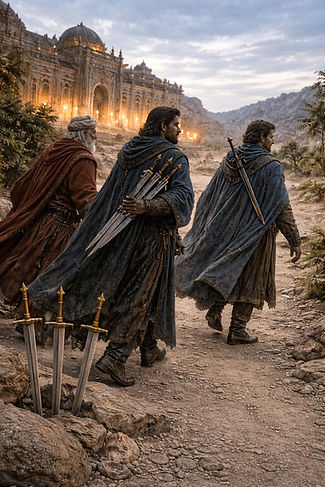
Without a word, John, Jim, and Xiang removed their outer garments. Beneath the dust and travel-worn cloth, golden embroidery emerged—royal robes long concealed. They knelt before the child.
Xiang saw nothing outwardly remarkable.
John and Jim did not look away.
The gifts were offered. Gold, frankincense, myrrh. The mother received them in silence, her confusion yielding to tears she did not restrain.
Jim reached her then—not with words, but with the discipline Isis had taught him. Reverence first. Then warning. They must flee. The child’s life was in danger. Herod would not remain ignorant for long, and the very authority granted to the magi had already begun to trace their passage.
The mother listened. Joseph understood.
Jim hesitated, then touched the child.
At first, there was nothing.
Then Yaohushua entered his consciousness—not as vision or symbol, but as presence.
Yes—I Am here. You see My Son, the light and hope of the nations. But now you must depart and complete what you have set yourself to do. You will return to Him near the end of your life. He will show you more concerning eternal life and draw you closer to Me. I promised you that you would see My Son. And here He is.
The presence withdrew.
The child slept.
Days later, Herod ordered the slaughter of Bethlehem’s children.
It was a futile act.
The young family had already fled, sustained by the gold left in their care. Rome did not pursue them. Rome never needed to.
Only Herod feared the child.
He lost the only kind of power that mattered.